
Home
Preamble
Index
Areas
Dales
Hills
Lakes
Places
Reserves
Rivers
Structures
Villages
References
Me
Saunterings: Walking in North-West England
Saunterings is a set of reflections based upon walks around the counties of Cumbria, Lancashire and
North Yorkshire in North-West England
(as defined in the Preamble).
Here is a list of all Saunterings so far.
Guaranteed ad-free, AI-free and free!
If you'd like to give a comment, correction or update (all are very welcome) or to
be notified by email when a new item is posted - please send an email to johnselfdrakkar@gmail.com.
241. The Wildlife of Aughton Woods
Yesterday I came across a report in the magazine of the
North Lancashire Wildlife Group
about a walk last April from my village Brookhouse to Aughton Woods. If it’s
good enough for NLWG then it’s good enough for me. After weeks of cloud, wind
and rain (although thankfully less rain than elsewhere in the country) and also
cold (the runny nose variety) we needed a convenient walk to get the legs moving again.
It was sunny and frosty, with no wind. As we walked down Holme Lane
towards the river I glimpsed the snowy tops of distant hills, which is always a
cheery sight. Then we heard hundreds of pink-footed geese swirling about, an
evocative sound of the Lune floodplain in winter. Ahead of us, on the riverside
fields, a flock of fifty oystercatchers seemed reluctant to move from our path – which
they eventually did. And all the while Ingleborough stood noble and resplendent at
the head of the valley.
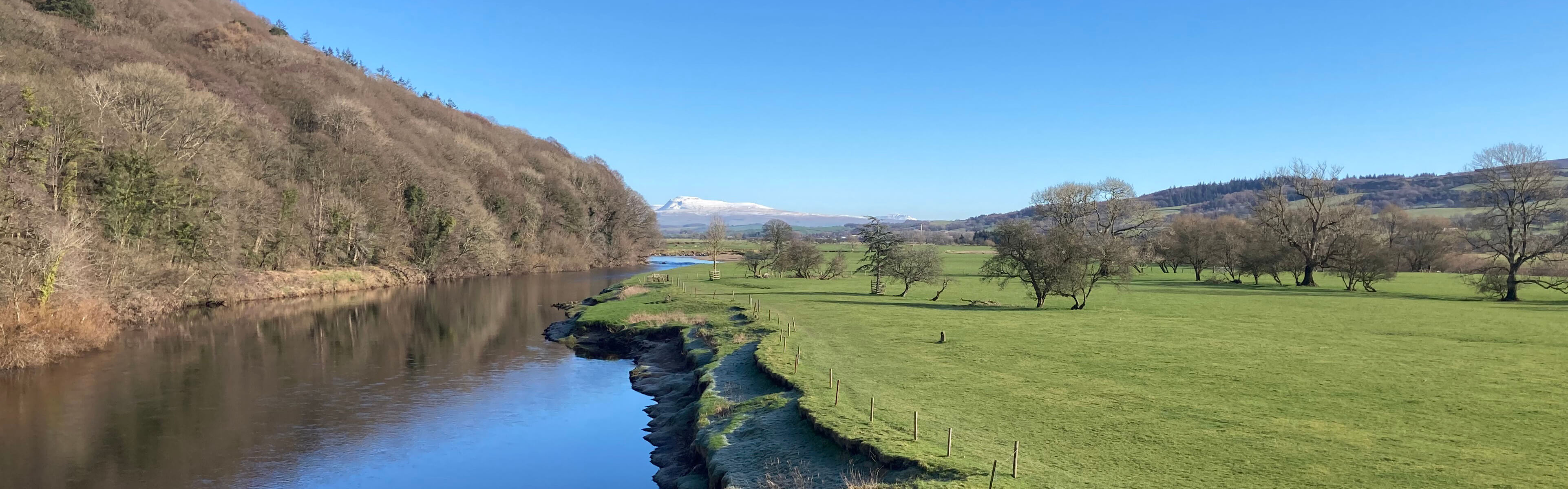
Ingleborough from the Waterworks Bridge, Aughton Woods to the left
I can’t help noticing that my Saunterings missives are somewhat different to the NLWG
reports. Their Aughton Woods report begins “In the car park we looked around the base
of a few trees spotting three 7-spot ladybirds … and a fly that had clearly been
killed by a fungus. This fungus is Entomorpthora muscae …”.
Perhaps I shouldn't be in a hurry to get underway but should instead spend some time looking
for dead flies in the car park.
Perhaps I shouldn't stride out on my walks but should instead inspect every leaf
looking for orange-belted leaf-lickers.
Perhaps I should learn the Latin name of at least one fungus and bee and
beetle and fly and ladybird in order to add some scientific gravitas to these words.
The NLWG report names seventeen species seen on
their walk – one algae, two bees, one bee-fly, one beetle, one bird (swift), one
fungus, two hoverflies, three ladybirds, one moth and four plants (including
bluebell and ramson). Of these, I could identify only the three I mention in
brackets. Clearly, the NLWG group were focussed upon the smaller members of the
natural world. I am glad somebody is.

I am reminded of the book The Fly Trap (Sjöberg, 2014). The Swedish
entomologist Fredrik Sjöberg writes eloquently about how a person can become focussed
upon, obsessed even, with a small part of the natural world. He himself is a
world-recognised expert on Swedish hoverflies. When I say ‘world-recognised’ I mean
recognised by the score or so people in the world who are interested in Swedish hoverflies.
The other eight billion of us are perplexed that anyone can find Swedish hoverflies
so fascinating, as Sjöberg is well aware. A book on Swedish hoverflies would
be read only by that score or so of people – unless it is turned into a wry
philosophical study of “finding happiness in the little things”, in which case it
may become a bestseller. There’s nothing wry about the NLWG report.
The NLWG report mentions only one species of bird seen on their walk. It does say that
they failed to see any sand martins, which is surprising. I keep an eye out for
the arrival of sand martins each year and they’re usually here on about April 1st.
So they were surely about on the date of their walk (April 26th) and they don’t
travel far from their river-bank nests. Whenever we walk to the river we would hope
to see several bird species – geese and oystercatcher, as mentioned (in winter), egret,
swan, kingfisher, ducks, and so on – and to hear various birds of the woodland.
On this occasion, however, I will admit that we didn’t see a great variety of birds.
We crossed Waterworks Bridge and walked into Aughton Woods. It being
February there was some slipping about on muddy paths but otherwise it was, as
always, a pleasant walk. The NLWG report says nothing at all about the most
important species of the woods – the trees. I suppose it is less impressive
to identify, say, a beech rather than, say, a dimorphic bearfly. In any
case, is it really necessary to identify the species in order to appreciate
being among the tall trees standing starkly elegant on the steep slopes?
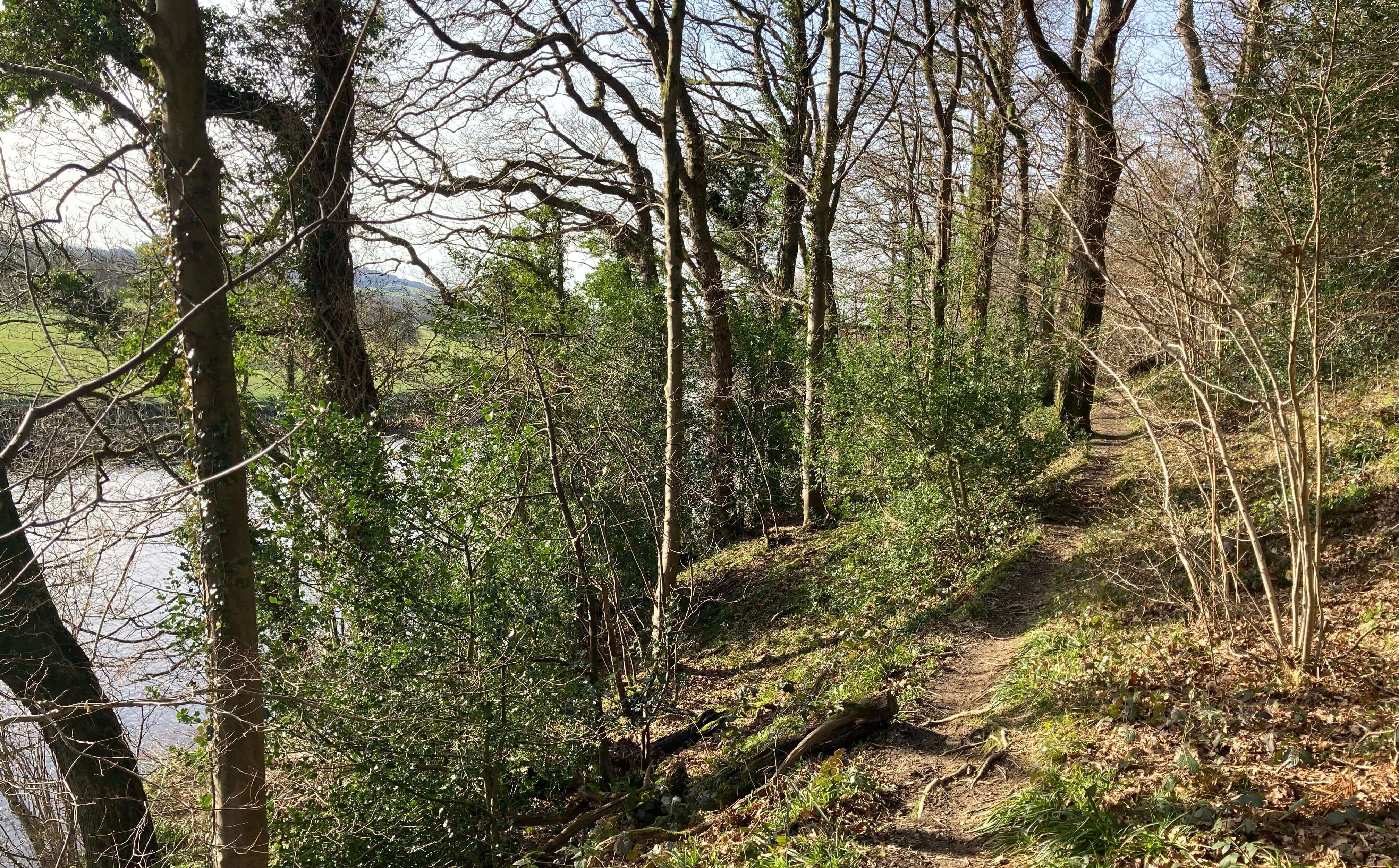
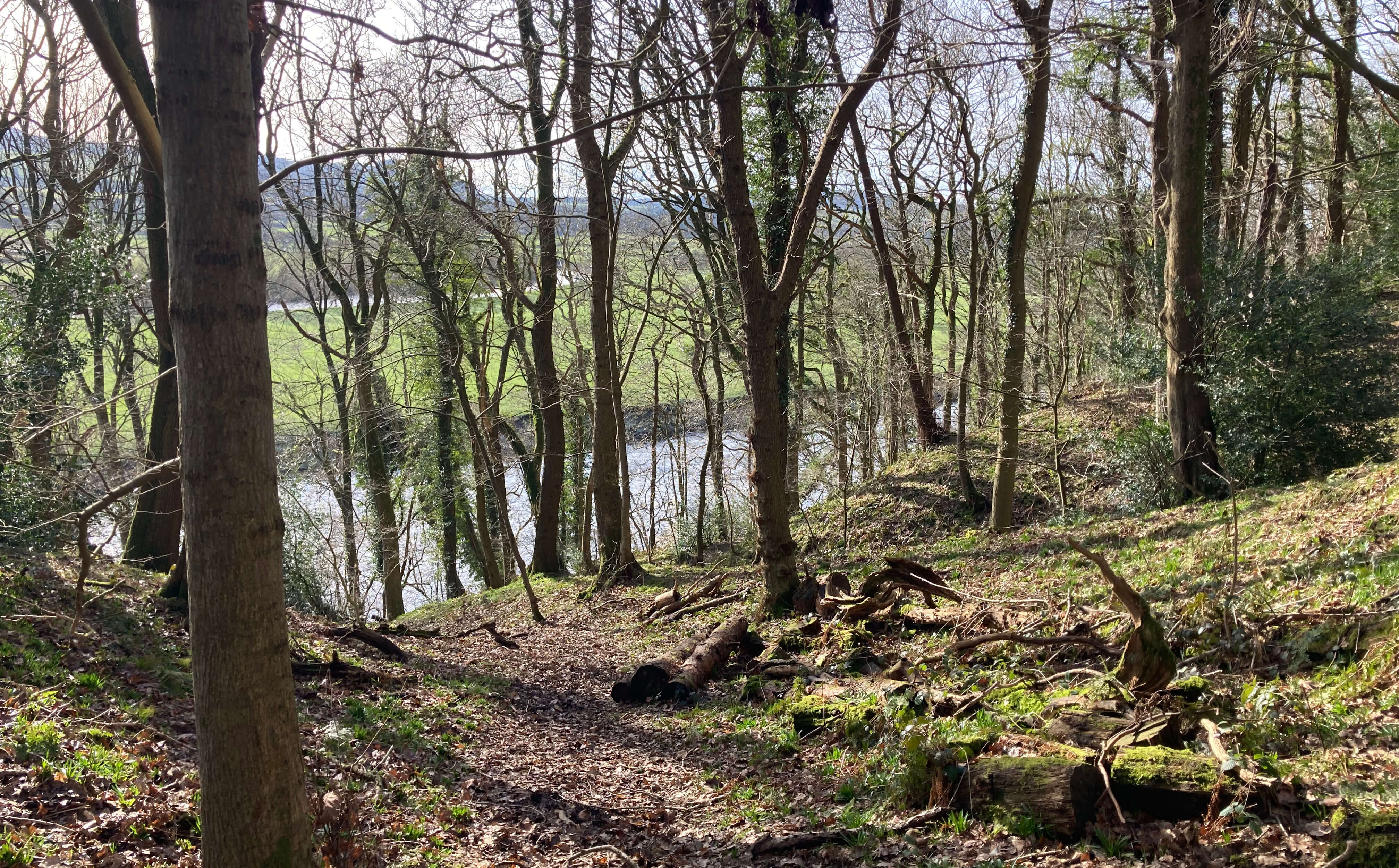
In Aughton Woods
We, however, associate Aughton Woods most with a particular species that
the NLWG report certainly does not mention – the badger. We have made three
expeditions to see the Aughton Woods badgers, decades apart, because we don’t
want to harass them.
The first attempt was rather frustrating. Well before sunset we
positioned ourselves downwind of what looked to us like an active sett and
waited for the badgers to emerge for their evening foraging. (The sett was
not right by the footpaths so I suppose we were trespassing: if so then
regard this as fiction.) Unfortunately they did not emerge before it was
too dark to see them. All we were aware of was
some rather unnerving snuffling and grunting.
We prepared better for the second visit. We sprinkled peanuts by
the sett’s exits to keep the badgers happy and in view – and we set up a
motion-sensitive light in case they emerged again in the dark. (I hope
that’s not illegal: if it is then regard this as fiction.) In the event,
the lights were not needed because the badgers came out in daylight. We
had an excellent view of them. At one point the badgers looked straight
at us but they have poor eyesight and therefore continued unperturbed.
Overall, we were in awe that such animals could be living wild within a mile
or two of our home.
The third visit was disappointing. The sett was clearly no longer
occupied. In fact, it seemed likely that it had been destroyed. The government
had decided to have badgers shot in order (they said) to reduce the spread of
bovine tuberculosis. This no doubt encouraged others (such as farmers) who
are not fond of badgers to get rid of them. It is a complicated issue.
Suffice to say that over 200,000 badgers have been killed under official
licence and no doubt thousands more unofficially. The licences are due to
end in 2026. The effectiveness of the
culling programme remains a matter of dispute.
Most of Aughton Woods is not accessible to the public and I would
expect there to be badgers still in the private parts of the woods. I have
been in two minds about mentioning the badgers at all because I know that
there are people who feel it their duty, or even their pleasure, to kill
them. I hope that doesn't apply to anyone reading this
because badgers are amazing animals to have living wild
almost in our midst. I would certainly rather see a badger than, say, a dark-edged bee-fly.
And I can even give a Latin name for badger: Meles meles.
The NLWG report leaves me concluding, as I have done before, that
while all the creepies, the crawlies, the wigglies, the slimies, and so
on are indeed part of wildlife in all its glory there are just too many of
them, all much of a muchness to me. I have no doubt that they are really
deeply fascinating in their own way but if I developed a serious interest
in, say, hoverflies then I’d have no time for anything else, which I’m sure
we’d all regret.
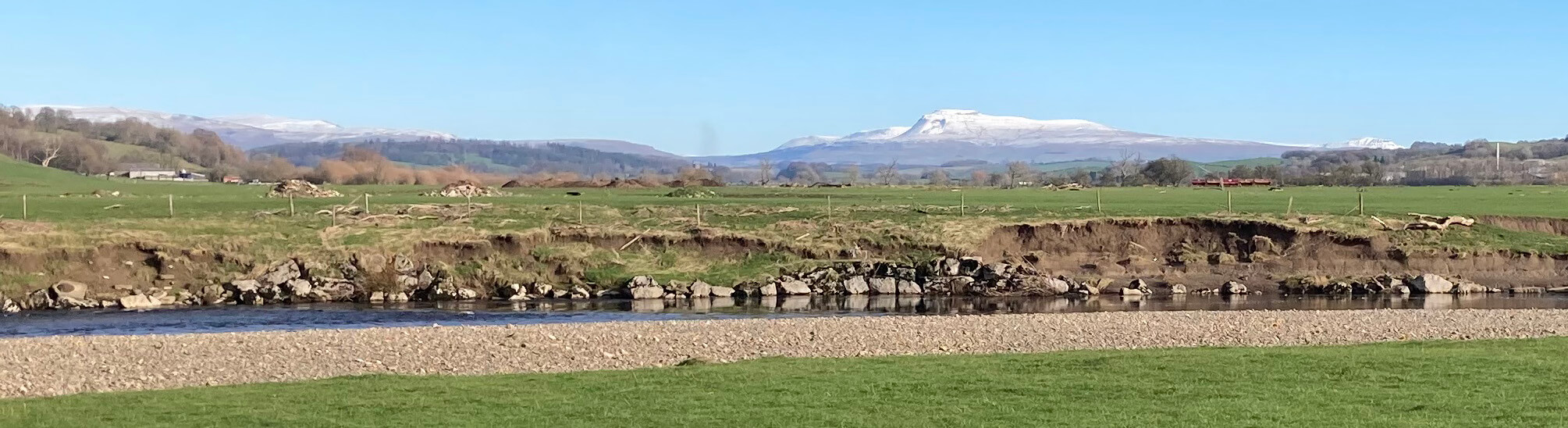
Ingleborough from the
river meander, with Whernside to the left and Pen-y-ghent to the right
(and yes I must get on the hills again)
Date: February 14th 2026
Start: SD543644, Brookhouse (Map: OL41)
Route: N – Waterworks Bridge – E in Lawson’s Wood (on lower
path, part of the Lune Valley Ramble) – N, SE through Lawson’s Wood (on upper
permissive path) – Waterworks
Bridge – E, S, W around meander – S – Brookhouse
Distance: 4 miles; Ascent: 40 metres
Home
Preamble
Index
Areas
Dales
Hills
Lakes
Places
Reserves
Rivers
Structures
Villages
References
Me
© John Self, 2018-

Top photo: Rainbow over Kisdon in Swaledale;
Bottom photo: Ullswater