
Home
Preamble
Index
Areas
Dales
Hills
Lakes
Places
Reserves
Rivers
Structures
Villages
References
Me
Saunterings: Walking in North-West England
Saunterings is a set of reflections based upon walks around the counties of Cumbria, Lancashire and
North Yorkshire in North-West England
(as defined in the Preamble).
Here is a list of all Saunterings so far.
Guaranteed ad-free, AI-free and free!
238. An Advent Adventure on Baines Cragg
My walks are of two kinds – those planned-to-be-a-Sauntering and those more
spontaneous, usually from home, just-a-walk. Occasionally the walks misbehave.
A planned Sauntering may not materialise for some reason and just-a-walk may
become a Sauntering (like that one by the river where we found United Utilities
up to something mysterious [207]). This is one of the latter.
As we live to the west of Caton Moor the sun is, at this time of the
year, a little tardy reaching us. When it does eventually turn up it sits low
upon the hill so that any walk uphill is into a dazzling sun. Nonetheless,
with Ruth safely embosomed in church on the first day of Advent, I set off
for a relaxing stroll on a bright and nippy morning, with no specific objective
in mind.
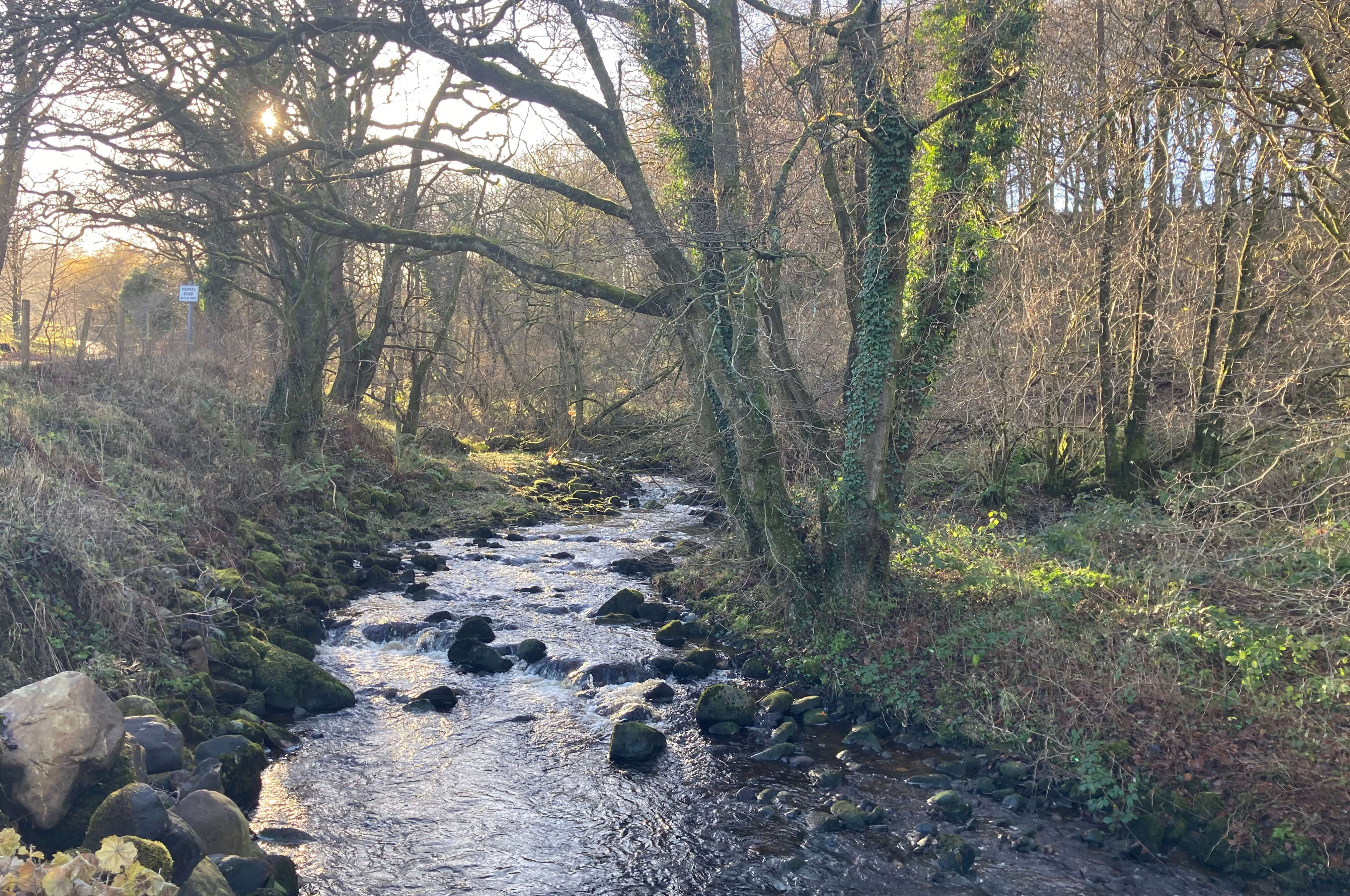 Left: Sweet Beck.
On these Sunday morning walks I sometimes wonder – but not for long –
whether they serve a kind of spiritual function in any way akin to those
experienced by church-goers. While villagers head for church
in their Sunday best as they have done for centuries, I set
out in the opposite direction in boots and beanie hat (not just boots and
beanie hat, I hasten to add).
Nowadays I come
across wordy treatises on ‘walking in nature’, ‘mindful walking’, and so on,
telling me that walking in our worldly paradise is intrinsically good, spiritually insightful, healing
and soul-renewing.
Well, I don’t walk mindlessly outside nature but am I really engaged in a
form of worship, expressing thanks for health and the natural world?
Obviously, I am not overtly religious (as otherwise I would be going
to church) but if I were I would expect more from religion than I have found
in walking. Those who try to spiritualise the nature of walking draw superficial
comparisons between congregations and walking groups, bibles and Wainwright guides,
and so on.
I suspect that the authors are just trying to raise their own walking onto a
holier-than-thou higher level than more mere mortals manage.
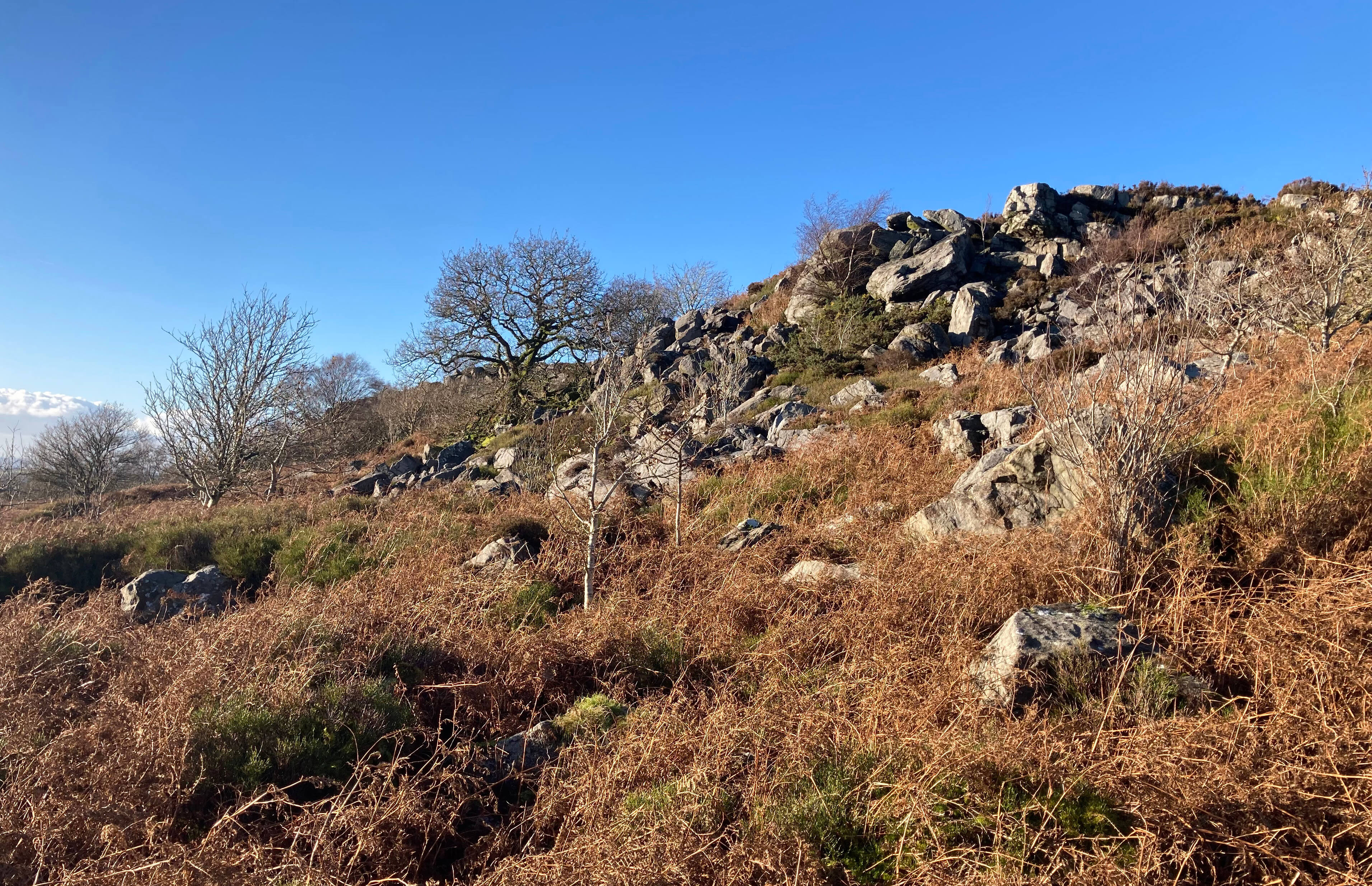 Right: Baines Cragg.
Just two hundred yards up our road there’s a view through a field gate
of distant hills. Only a tiny slice of the hills is visible and it is therefore
hard to identify which hills they are. However, I could see that the hills were
freshly and uniformly covered in snow, which when the hills are put into context
by walking further up the road shows them to be the Howgills, some thirty miles
away. The Lake District hills, when they came into view, were seen also to be
snow-covered but because they are rockier they never appear as smoothly white as the
generously iced cake of the Howgills.
It was pleasant indeed, basking in sunshine, walking up the Littledale
Road. Only a couple of the windmills were making an effort to move. There was
hardly any traffic – just a few cyclists. Is there a literature about ‘cycling
with nature’ and ‘mindful cycling’? If not, why not?
I think that it is pushing it to say that walking is or can be a spiritual
or religious activity, although it could be said that walking is an activity that
allows or encourages spiritual or religious thoughts.
Walking provides a time and a place to commune with God and for spiritual renewal.
Far be it from me to imply that walkers should not commune with God as they walk,
if they wish. Those religiously inclined might well wish to do so, as with all
their other activities. It is better for them to think about God while walking
than it would be for me to think about walking when in church.
As I neared the old track to Crossgill I decided to turn south to head
for The Cragg (that is, the region of The Cragg farm and the rocky outcrops of Little Cragg and Baines
Cragg) from where there were likely to be fine views. It used to be a regular
Sunday morning run up here but now it is probably over a year since I’ve walked
up. I dropped down to cross Foxdale Beck and Sweet Beck, from where I knew that
it was quite a steep climb – so I took my time.
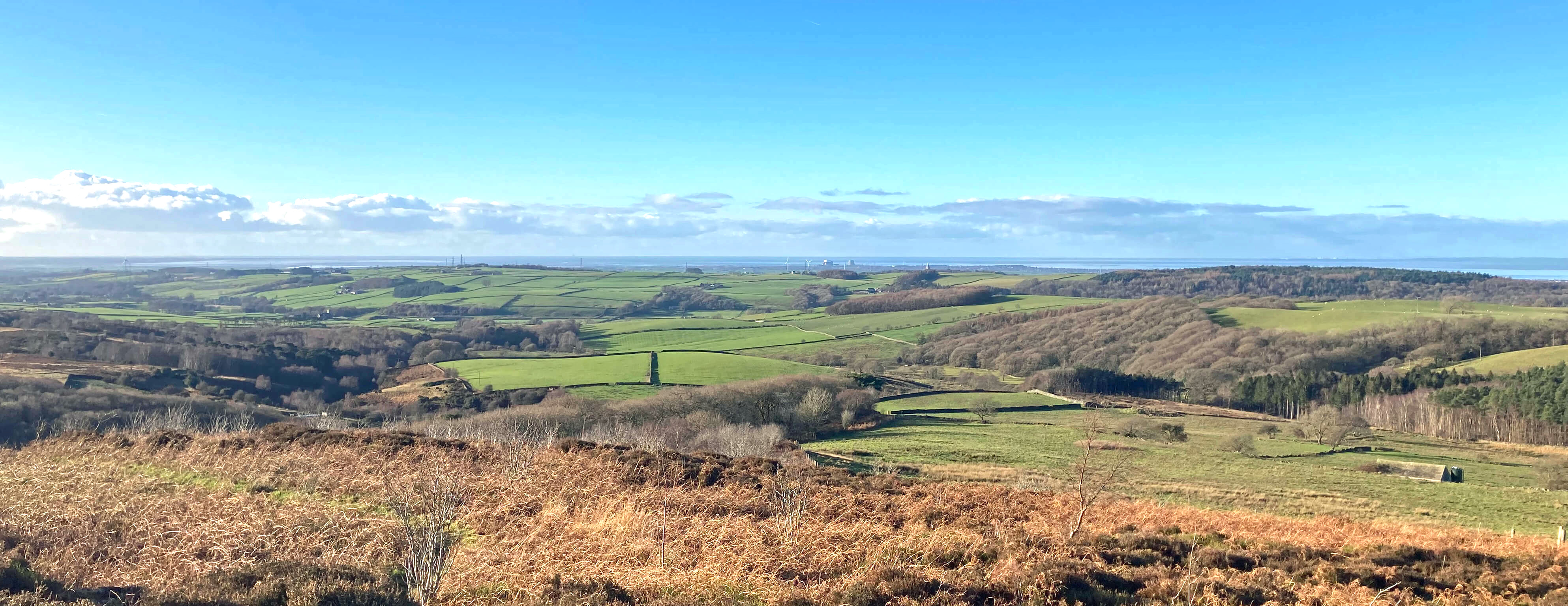
The view from Baines Cragg over Lancaster and Morecambe to Morecambe Bay
When I reached the top of Baines Cragg (214 metres) I found a man already
stood there, admiring the view. He said that he had driven here from near Preston.
I don’t think that he had a particular attachment to Baines Cragg, as he didn’t
seem to have much idea of what he was looking at. He had presumably come here
on a whim – much like me.
He eventually left. I stayed for a while. The Ward’s Stone – Clougha
Pike ridge was in shade but elsewhere was clear if not as precise as sometimes.
I could see Blackpool Tower but clouds over Morecambe Bay hid the Isle of Man.
The Lake District panorama, from Black Combe northward, was all in view, and it
seemed that the snow cover did not begin until Bowfell and the Langdale Pikes.
Then there’s the bright white Howgills and the Dales hills as far as Whernside, the
other two of the Three Peaks being hidden by Caton Moor. Below lay the Lune valley with
my home village not quite visible.
It was all just as I hoped and expected but very welcome for all that – but
hardly a transcendent revelation.
And then I set off down.

The view from Baines Cragg to Caton Moor (Whernside is just to
the left of the windmills)
Does walking make you more spiritual than you might otherwise be? No
doubt it depends what ‘spiritual’ is taken to mean, which is too complex an issue
for me. Personally, I can only say that walking makes me feel better but hardly
a better person. I never have explicitly religious thoughts while walking, in the
sense of, for example, thanking God for creating this universe. But then I am
much more in awe of the wonders revealed by science than any miracles in the bible.
Is it not amazing that, as I stand on Baines Cragg (or indeed anywhere),
elementary particles (neutrinos) that nobody even
suspected the existence of just a hundred years ago are always passing right
through me? In fact, 100,000,000,000,000 of them do so every second! And most of
them pass through the Earth too. And is it not almost incredible that I am also
receiving microwave radiation that has been travelling towards me for over
13,000,000,000 years? I don’t feel in need of the miracles of five fishes and
two loaves when there are such natural miracles to contemplate. Or perhaps I
should try harder to interpret for today statements such as that on the fourth day
God created the sun and the moon and, as an afterthought, “He also made the stars”
(all 1,000,000,000,000,000,000,000,000 of them).
It is not so much the ‘content’ as the methodology that turns me to science.
Religion seems to require an unquestioning faith in (or at least a preparedness to
go along with) millennia-old dogma. Science
involves a perpetual search for a deeper understanding, while accepting that the
understanding we think we have now is always falsifiable. I appreciate, however,
that religion provides a community consensus that comforts many (and enables Christmas!).
 Left: The sign for Carr House.
Although I don’t think that walking has much to do with religion, it seems
that religions expect that their followers should do a lot of walking. There are
pilgrimages galore, to, it seems, every place were some significant religious event
occurred. For example, every year half a million people walk the Camino de Santiago
in Spain, a Catholic pilgrimage of many paths converging on the shrine of the apostle James in the Cathedral of
Santiago de Compostela.
 The British Pilgrimage Trust ("walk
for your body, pilgrim for your soul") lists
about 250 pilgrimages. Whether or not they are really pilgrimages I leave others
to judge. Only a few of them are in north-west England
and I won't be walking any of them.
The British Pilgrimage Trust ("walk
for your body, pilgrim for your soul") lists
about 250 pilgrimages. Whether or not they are really pilgrimages I leave others
to judge. Only a few of them are in north-west England
and I won't be walking any of them.
Sometimes the pilgrimage emphasises the walking itself and sometimes the
destination to be reached. In the former case, the walking may be made more arduous
than it would normally be, in order to better demonstrate penance and atonement.
For example, a walk up Croagh Patrick in Ireland, a place of pilgrimage for over
1,500 years, is traditionally walked barefoot.
Those tackling the Mecca pilgrimage
are allowed nowadays to get there without walking – but once there they must walk
seven times anticlockwise around the Kaaba, the shrine at the centre of the Great Mosque.
This Hajj is mandatory for
capable Muslims, to cleanse their souls of all worldly sins.
Other religions also have a fascination with walking. Forgive me
for not researching this thoroughly – it would require me to read more religioniana
than I can cope with. I understand that Buddhists have a devotion to walking around
sacred objects, such as mountains. In particular, a walk around Mount Kailash (6,638
metres high, 32 miles around) in Tibet will apparently absolve the sins of a lifetime.
I rather like the notion that the very top of the mountain is a sacred place
where humans should not tread and that we should instead walk around it.
Hindus have several walking practices, such as long-distance pilgrimages
(for example, the two-month Paada Yatra in Sri Lanka), clockwise circumambulations of temples
(Pradakshina), and fire-walking (Thimithi), that is, walking over burning coals to receive
a blessing from the goddess Draupadi.
Wikipedia comments that the "prolonged suffering involved in this and similar rituals can
result in feelings of euphoria for participants, an effect similar to the
marathon 'runners high'". I ran a few marathons but I never experienced euphoria
(although I may afterwards have expressed gratitude to God – "Thank God that's over").
Somewhat similarly, Taoism has a number of walking meditations. For example,
Bugang is a nearly 2,000-year-old practice of walking to trace out some pattern, such as
the stars of the Dipper, while performing incantations. Also,
an integral part of Baguazhang, a martial art, is the practice of ‘walking in circles’.
This technique is thousands of years old and is based on the Taoist principle of seeking
stillness in motion. The diameter of the circle looks so small to me that I think it would be more
liable to make me dizzy.
My walks from home are circular too or, rather, loops – except this one, because
I just retraced my steps to get back home, sadly uncleansed of my multitudinous worldly sins.
And so to Christmas, if I'm allowed.
Date: November 30th 2025
Start: SD543644, Brookhouse (Map: OL41)
Route: SE on Littledale Road – New House, Udale Bridge – SW – The Cragg – W –
Baines Cragg – and back
Distance: 6 miles; Ascent: 190 metres
911 +486 /2400
Home
Preamble
Index
Areas
Dales
Hills
Lakes
Places
Reserves
Rivers
Structures
Villages
References
Me
© John Self, 2018-
Contact: johnselfdrakkar@gmail.com

Top photo: Rainbow over Kisdon in Swaledale;
Bottom photo: Ullswater