
Home
Preamble
Index
Areas
Dales
Hills
Lakes
Places
Reserves
Rivers
Structures
Villages
References
Me
Saunterings: Walking in North-West England
Saunterings is a set of reflections based upon walks around the counties of Cumbria, Lancashire and
North Yorkshire in North-West England
(as defined in the Preamble).
Here is a list of all Saunterings so far.
Guaranteed ad-free, AI-free and free!
If you'd like to give a comment, correction or update (all are very welcome) or to
be notified by email when a new item is posted - please send an email to johnselfdrakkar@gmail.com.
253. Cockermouth and Dorothy Wordsworth
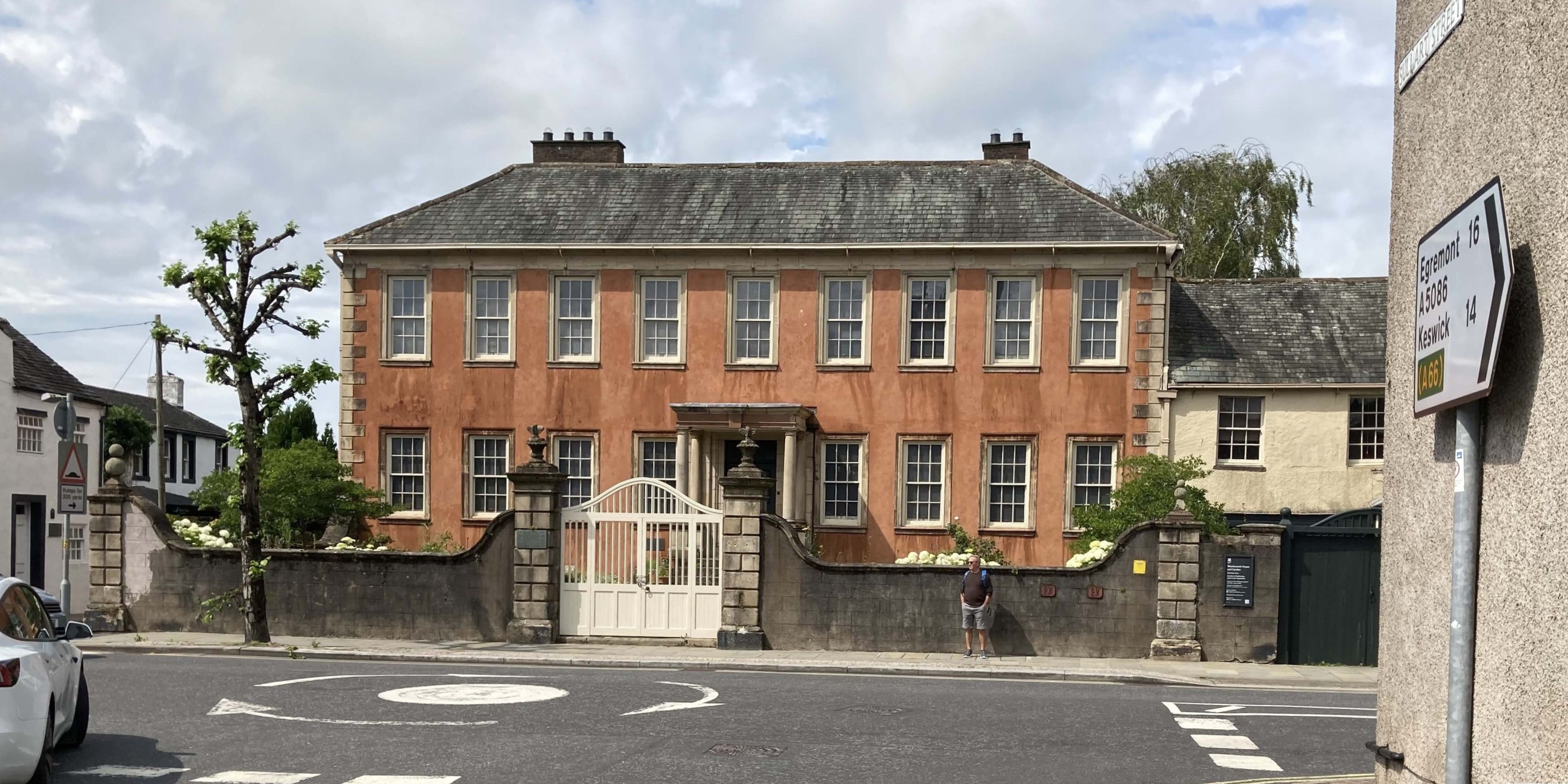 Dorothy Wordsworth, the renowned nature diarist, was born in 1771 at Wordsworth House in
Cockermouth – except that it wasn’t called Wordsworth House then. After the death of her
mother in 1778 she was sent to live with relatives in Halifax and then Penrith. Like
most girls of the time, she received little formal education and escaped the stultifying
hand of Oxbridge. This enabled her to develop her personal perceptions of nature and style
of writing, with the result that Nicholson (1955) was able to express the opinion that
her Grasmere journals, which were not intended for publication,
are “supreme” among Lake District prose and that
Dorothy Wordsworth, the renowned nature diarist, was born in 1771 at Wordsworth House in
Cockermouth – except that it wasn’t called Wordsworth House then. After the death of her
mother in 1778 she was sent to live with relatives in Halifax and then Penrith. Like
most girls of the time, she received little formal education and escaped the stultifying
hand of Oxbridge. This enabled her to develop her personal perceptions of nature and style
of writing, with the result that Nicholson (1955) was able to express the opinion that
her Grasmere journals, which were not intended for publication,
are “supreme” among Lake District prose and that
“no one, indeed,
in the whole of English literature has such a gift of evoking the natural world, of
bringing it before our eyes.”
Yes, Nicholson was referring to Dorothy and not to her better-known brother,
William (born 1770). William, as has been well documented, was indebted to his
sister for inspiration for some of his poetry and indeed for life support. William,
however, does not appear to have thought so highly of Dorothy’s (or anyone else’s)
perceptions of nature, saying (as quoted in
McCracken, 1984, p186)
“I have hardly ever known anyone but myself who had a true eye for
Nature, one that thoroughly understood her meanings and her teachings.”
It takes a degree of arrogance to assert that one’s own eye for nature, however
perceptive, is a ‘true’ eye, truer than anyone else’s.
 As an exemplar of Dorothy's style, Nicholson (1955) quoted the following
passage from her Grasmere journal of 16 April, 1802 - and if it impressed the
esteemed Cumbrian poet Norman Nicholson then I am happy to include it here:
As an exemplar of Dorothy's style, Nicholson (1955) quoted the following
passage from her Grasmere journal of 16 April, 1802 - and if it impressed the
esteemed Cumbrian poet Norman Nicholson then I am happy to include it here:
There was the gentle flowing of the stream, the glittering, lively lake,
green fields without a living creature to be seen on them, behind us,
a flat pasture with forty-two cattle feeding; to our left, the road leading to the hamlet.
No smoke there, the sun shone on the bare roofs.
The people were at work ploughing, harrowing, and sowing ... a dog
barking now and then, cocks crowing, birds twittering, the snow
in patches at the top of the highest fells, yellow palms,
purple and green twigs on the birches, ashes with their
glittering spikes quite bare.
Nicholson described Dorothy’s response to nature as “tremulously sensitive”
but went on to say that
“... she was no naturalist. She was not able to distinguish between the
song of the thrush and that of the blackbird, she confused the yew with the juniper,
hart’s tongue with adder’s tongue, and she scarcely knew more than a score or two
of wild flowers by their names.”
I expect that much the same could be said of William.
Dorothy and William saw nature with the eyes of poets and, like all artists
of the time, they focussed upon the aspects of beauty and sublimity. And that has
coloured, in fact distorted, our view of nature ever since. Their ‘true’ eye for
nature is not the only, or even the most appropriate, one. I can imagine Dorothy
quivering at the sweet fragrance and delicate flowering of Himalayan balsam but
if she didn’t know what it is or what its properties are then she wouldn’t know
how best to react to it, namely, by uprooting it. It is not enough to respond
emotionally to what we see of nature. We have a duty, since we have made a mess of
it, to know enough to be able to do what we think is best for nature as a whole.
Dorothy is squeezed in as a footnote to William on the plaque at Wordsworth
House. Dorothy and William may have had a difficult few years in Cockermouth.
Their home, with its seventeen large windows at the front, is hardly a modest
abode, compared to other houses in the town. But their parents were not nobility.
In fact, their father worked for Sir James Lowther (1st Earl of Lonsdale), who
owned many of the coal-mines and iron works in the region and was not a popular
figure, which can’t have helped them mix freely with the Cockermouth children. The
Wordsworth parents did not own Wordsworth House: it came with the job.
We walked along Main Street, which was colourfully garlanded, with flowers
down the middle of the road (I don’t know if it always is or whether there was some
special event), plus a white statue of the 6th Earl of Mayo, local MP from 1857 to
1867. Cockermouth has a degree of sturdy elegance, being at the transition from
the Lake District proper to the once industrialised coastal region, a transition that
corresponds to the change from Skiddaw slate to the limestone of the coastal belt.
The buildings are usually not of exposed grey stone, as in Ambleside and Keswick,
say, but have been rendered smooth, often painted white or close to it, with bolder
colours framing windows. Cockermouth is no longer industrial, with all of its dozen
or so mills having gone, although the brewery seemed to be active or, at least,
the buildings are still there.
We crossed the River Cocker just as it enters the River Derwent. Cockermouth
is probably the only town in England ending with “-mouth” that isn’t a sea-side town.
It seems here that a tributary entering its main river has a mouth. Those two rivers
carry all the water that flows into and then out of five lakes: Derwent Water,
Bassenthwaite Lake, Buttermere, Crummock Water and Loweswater. As a result,
after prolonged heavy rain on the fells, Cockermouth
is prone to serious flooding, with hundreds of properties being inundated in 2005,
2009 and 2015. It is to be hoped that the new flood defences help.

The River Derwent at Cockermouth. The River Cocker enters the Derwent just
below the white house seen in the middle. Cockermouth Castle is hidden by the trees ahead.
Left: All we could see of Cockermouth Castle.
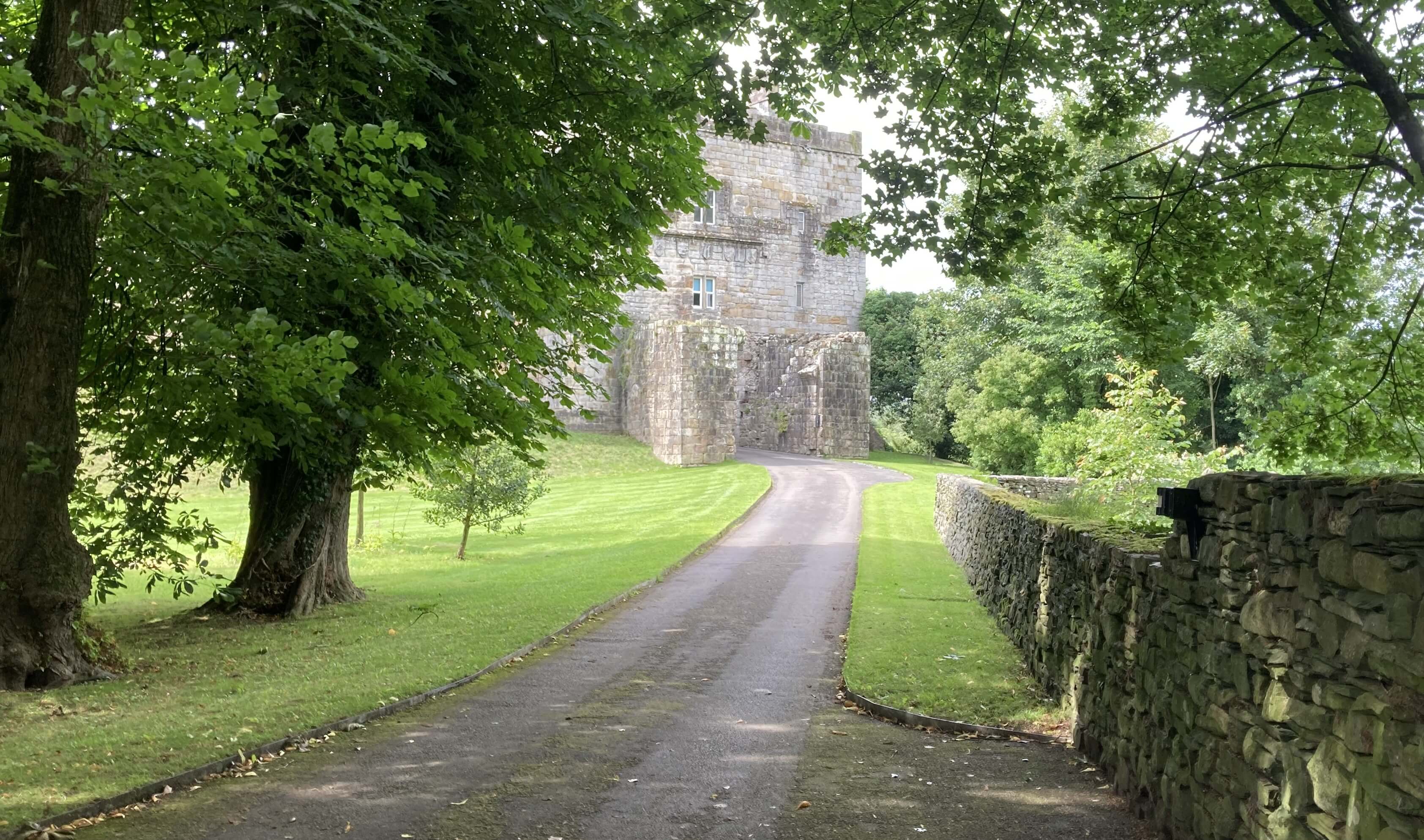
We walked up to Cockermouth Castle, built on a mound between the two rivers and
dating back to 1134. This castle had an active past, being involved with conflicts with
Robert the Bruce, the Wars of the Roses and the Civil War but in 2008 was placed on the
‘Heritage at Risk Register’ maintained by Historic England. It is probably even
more at risk now after the flood of 2015 washed away part of the nearby river bank.
Today the castle is a private residence and we could see little of it. (It is best
viewed apparently from the other side of the River Derwent.)
Some of the stone for the castle was taken from the Roman fort of Papcastle
just a mile or so down river. This and no doubt many other extractions have left
nothing to see on the green fields of the fort area, apart from grassy mounds, although
excavations have been carried out to try to determine the properties of the fort.
The 2009 flood washed away a metre of soil from ground south of the River Derwent to
reveal artefacts showing that the Roman site extended further south than previously thought, when the Derwent itself must have flowed further south than it does today.
The Romans had a road from Cockermouth to their fort at Maryport and we too
headed that way … on the following day [254].
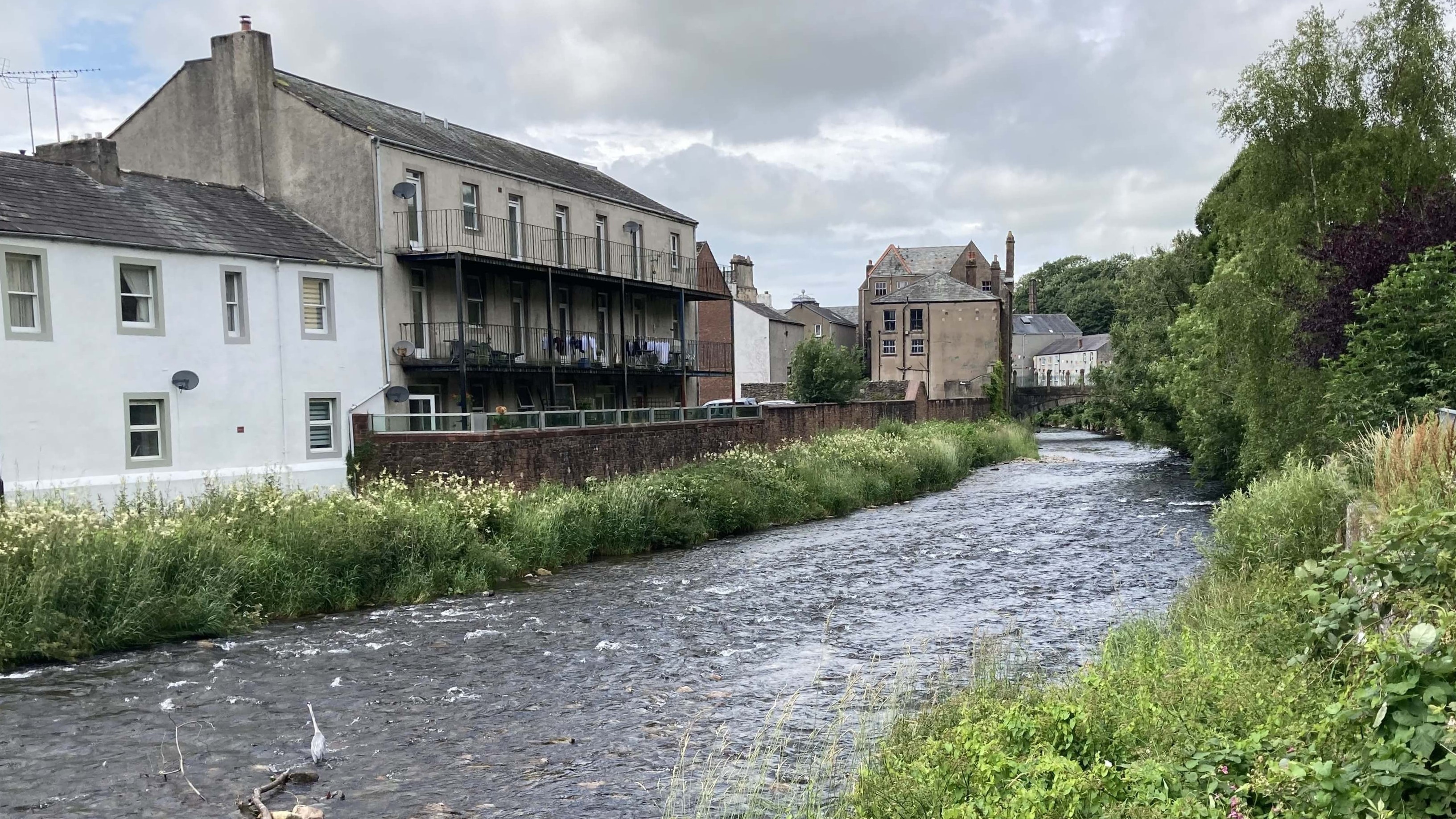
The River Cocker.
Date: July 6th 2026
Start: NY117308, Memorial Gardens car park, Cockermouth (Map: OL4)
Route: around the lanes of Cockermouth
Distance: 2 miles; Ascent: 30 metres
Home
Preamble
Index
Areas
Dales
Hills
Lakes
Places
Reserves
Rivers
Structures
Villages
References
Me
© John Self, 2018-

Top photo: Rainbow over Kisdon in Swaledale;
Bottom photo: Ullswater